This website is not affiliated with or endorsed by Miami International Airport (MIA). All trademarks belong to their respective owners.
This website is not affiliated with or endorsed by Miami International Airport (MIA). All trademarks belong to their respective owners.
Miami International Airport (MIA) and San Francisco International Airport (SFO) process significant passenger traffic between the southeast region and the California Bay Area. This document presents route-specific information for mia to sfo flights. Operational parameters, carrier offerings, fare structures, and terminal facilities are detailed.
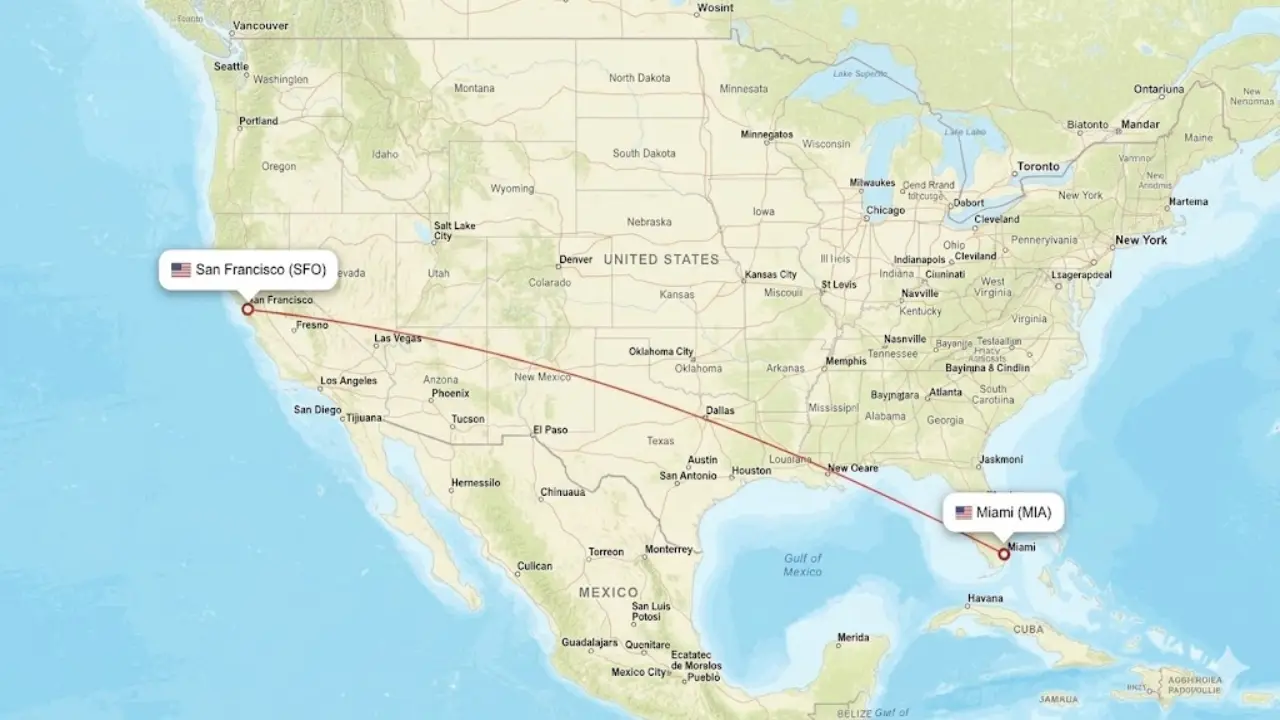
The spatial relationship between Miami and San Francisco establishes fundamental operational requirements for all carriers on this sector. This distance directly affects miami to san francisco flight time calculations.
Spatial Measurement:
The great-circle distance between MIA and SFO measures 2,585 miles. Transcontinental routes of this length require specific aircraft range capabilities.
Time Aloft Determinants:
Multiple factors influence actual airborne duration for mia to sfo flights.
Atmospheric Currents: The jet stream flows west to east at high altitudes. Westbound aircraft penetrate this current, increasing resistance and extending flight time. Eastbound aircraft receive tailwind assistance, reducing duration.
Seasonal Intensity: Winter months generate stronger jet stream activity, amplifying the time difference between directional flights.
Path Modifications: Air traffic control may alter flight paths due to weather systems or congestion.
Standardized Block Times:
Westbound Sector (MIA-SFO): 6 hours to 6 hours 20 minutes
Eastbound Sector (SFO-MIA): 5 hours to 5 hours 35 minutes
|
Operational Parameter |
Value |
|
Inter-Airport Distance |
2,585 miles |
|
Westbound Scheduled Time |
6h – 6h 20m |
|
Eastbound Scheduled Time |
5h – 5h 35m |
Multiple airlines maintain scheduled service on this corridor. Passengers searching for flights to miami from sfo encounter distinct service propositions from each carrier.
Legacy Carrier Operations:
American Airlines: Schedules daily non-stop service utilizing Boeing 737-800 and Airbus A321 equipment. These flights connect American's Miami hub with its San Francisco focus city.
United Airlines: Operates multiple daily frequencies from its San Francisco hub to Miami. Aircraft deployed include Boeing 737-900 and Airbus A319/320 series.
Delta Air Lines: Maintains daily service with seasonal frequency adjustments. Equipment assignments include Boeing 757-200 and Airbus A321 aircraft.
Value-Based and Connecting Carriers:
Several airlines provide service with intermediate stops.
JetBlue: Routes through New York-JFK or Boston
Spirit: Connects through various network points
Alaska: Links through Los Angeles or Seattle
Frontier: Utilizes multiple hub connections
Mia to sfo flights follow structured daily schedules. Understanding frequency patterns assists with itinerary selection.
Daily Service Volume:
The route supports 8 to 10 non-stop operations daily across all carriers. American and United combined represent approximately 80 percent of this capacity.
Temporal Departure Clusters:
Airlines concentrate departures into specific time blocks.
Early Bank: 6:00 AM – 9:00 AM departures from Miami
Midday Bank: 1:00 PM – 3:00 PM departures
Night Bank: 8:00 PM – 10:00 PM departures (overnight service)
Time Zone Impact:
Pacific Time operates three hours behind Eastern Time. A 7:00 AM Eastern departure from Miami arrives San Francisco at approximately 9:30 AM Pacific. This timing enables same-day business activities on the west coast.
Airfare on this route responds to demand fluctuations and booking behavior. Miami to san francisco flights exhibit identifiable pricing patterns.
Demand Fluctuation Cycles:
High Demand Periods: Summer months (June-August) generate peak leisure travel demand. Holiday periods also show elevated booking activity.
Low Demand Periods: January-February and September-October record reduced demand, leading to lower fares.
Business Travel Impact: Monday through Thursday departures often carry higher fares due to corporate travel patterns.
Booking Timing Effects:
Advance purchase analysis reveals consistent patterns.
Optimal Purchase Window: 30-60 days before departure
Moderate Savings Period: 14-30 days before departure
Premium Pricing Period: 0-14 days before departure
Carrier Price Positioning:
American and United generally maintain comparable pricing on non-stop service. Connecting carriers may show lower base fares but require additional travel time.
|
Purchase Timing |
Price Level |
|
60+ days prior |
Competitive |
|
30-60 days prior |
Optimal |
|
14-30 days prior |
Moderate |
|
0-14 days prior |
Premium |
Punctuality data provides objective measures for mia to sfo flight status monitoring.
Delay Causation Factors:
Weather Phenomena: Miami experiences afternoon thunderstorms primarily May through September. These conditions halt ground operations during lightning events. San Francisco experiences marine layer fog events, particularly June through August, which reduce arrival rates. Information about ground operation protocols is maintained in MIA Ground Services documentation.
Airspace Constraints: The route traverses multiple air route traffic control centers. Congestion may require routing adjustments.
Aircraft Continuity Effects: Delays on previous flight segments propagate through the daily schedule. Morning flights demonstrate better on-time performance.
Statistical Performance:
Industry data indicates transcontinental routes experience delays on 18-22 percent of operations. Average delay duration ranges from 45 to 90 minutes.
Optimal Travel Day Selection:
Tuesday and Wednesday: Lowest delay probability
Saturday: Moderate delay probability
Friday and Sunday: Highest delay probability
Airport facilities affect passenger processing for miami to san francisco flight duration planning. The Miami Airport Terminal Map provides detailed layout information.
Miami International Airport Departure Facilities:
American Airlines: Concourse D, Gates D1-D60. Facilities include Admirals Club lounge and multiple dining options.
United Airlines: Concourse G, accessed through the North Terminal complex. United Club lounge available.
Delta Air Lines: Concourse H, with Sky Club lounge access.
MIA operates a terminal connector train (MIA Mover) between concourses.
San Francisco International Airport Arrival Facilities:
Terminal 1 (Harvey Milk Terminal): Serves American and Delta arrivals. Features renovated facilities.
Terminal 3: Serves United arrivals. Contains multiple lounges.
International Terminal: Some flights may arrive at International Terminal gates.
SFO AirTrain System:
This automated people mover connects all terminals, parking structures, rental car center, and BART station. Trains operate 24 hours daily.
After completing miami to san francisco: flight time, multiple transportation modes serve onward travel.
Rail Transit Options:
BART: Provides direct service to downtown San Francisco and East Bay cities. Trains operate from approximately 4:00 AM to midnight weekdays.
Caltrain: Connecting service via BART to Millbrae station for Peninsula cities.
Road-Based Transportation:
Taxis: Flat-rate pricing to San Francisco destinations.
Rideshare Services: Designated pickup zones at each terminal.
Hotel Shuttles: Complimentary service for guests of area hotels.
Rental Cars: Consolidated facility accessible via AirTrain.
The Miami-San Francisco air route handles significant transcontinental traffic through daily non-stop service. Mia to sfo flight time averages six hours westbound due to prevailing wind patterns. Flights from miami to san francisco operate from multiple concourses at MIA. Fare structures show lowest prices during January-March and September-October. Booking 30-60 days in advance captures optimal pricing. Tuesday and Wednesday departures offer highest on-time probability.
Jet stream direction primarily determines duration. Westbound flights against headwinds take approximately one hour longer than eastbound flights.
American Airlines, United Airlines, and Delta Air Lines operate non-stop service.
January through March and September through October typically show lowest average fares.
Pacific Time is three hours behind Eastern Time. A 10:00 AM departure from Miami arrives San Francisco at approximately 12:30 PM Pacific.
Booking 30-60 days before departure provides optimal fare availability.
Airline mobile applications provide real-time status updates. Updates on ground operations can be accessed through MIA Ground Services resources.
BART rail service, taxis, rideshares, hotel shuttles, and rental cars provide comprehensive ground access.
The great-circle distance between MIA and SFO measures 2,585 miles.
